The new hybrid work model
Mon, 27 Dec 2021
Teleworking, coworking, workout, flexwork, coliving, digital nomads, burnout, hybridization, flexible spaces, homeoffice, bleisure, Total Revenue Management,..... The pandemic has filled the news with headlines full of anglicisms giving us data, ideas and guidance that something is happening in the world of work.
Overnight, in March 2020, we went from a basically face-to-face model (which we had never seriously questioned), to a completely remote and, moreover, home-based model. Without time to think about it, better or worse, companies and professionals adapted their methods and spaces to be able to continue producing.
The passing of the months began to reveal things, many things. Some of them very good. Others, not so good. And the decline of the COVID, God willing it will not return with the same virulence triggered by new strains, brings us back to a kind of normality to which we arrived transformed. Among many other things, we ask ourselves whether purely face-to-face work is the best model once our lifestyle has changed, and in what way, after the pandemic.
The process of digitization of Society as a consequence of this short but intense period since March 2020, has opened a debate on how to adapt work to this new lifestyle in which most of the work can be done remotely. What is going to be the right model from now on.
Facts, statistics and trends.
It might be a good idea to review the data and surveys conducted during the pandemic.
Savills Aguirre Newman published last September the results of a survey of a universe of 100,000 people. And that survey shows some surprising results:
- 87% of employees in Europe believe that the office is essential.
- 12% say they would work in flex or coworking spaces, up from just 3% in 2019.
- Twenty-seven percent of respondents answered that they would use an office close to home in addition to their own if they had the option.
Bloomberg estimates that 39% of workers would quit their current job if they were forced to return to their usual job permanently....
PwC and KPMG indicate that only 19% of companies will return to the purely face-to-face model, and that 38% of Spanish CEOs assume a hybrid model with more than 2 days of remote work.
The data seems to indicate that the future points to the workplace being linked to the professional and not the other way around. Sometimes we will go to the office and sometimes we will stay at home working. But it is clear that these will not be the only options. Flexible spaces will have more and more weight and presence.
JLL ventures to predict that in 2030 30% of jobs will be of this type.
The world of Coworking, or the rental of flexible professional spaces, is nothing new, in fact it was born in San Francisco at the beginning of the century and, despite having had a significant growth, it has not acquired a global dimension until the advent of COVID-19.
In Spain, recent studies indicate that the volume of potential teleworkers is much higher than the supply of flexible workspaces for rent. According to the BdE (Banco de Espana ("El teletrabajo en Espana". Articulos Analiticos 2/2020. Brindusa Anghel, Marianela Cozzolino and Aitor Lacuesta), more than 6M Spanish professionals could do it which is an increase of x3.7 with respect to the number of professionals who did it in 2019.
In addition, when sizing the market and market trends, it is important to note that, despite an increase in remote work, Spain is still well below its European counterparts.
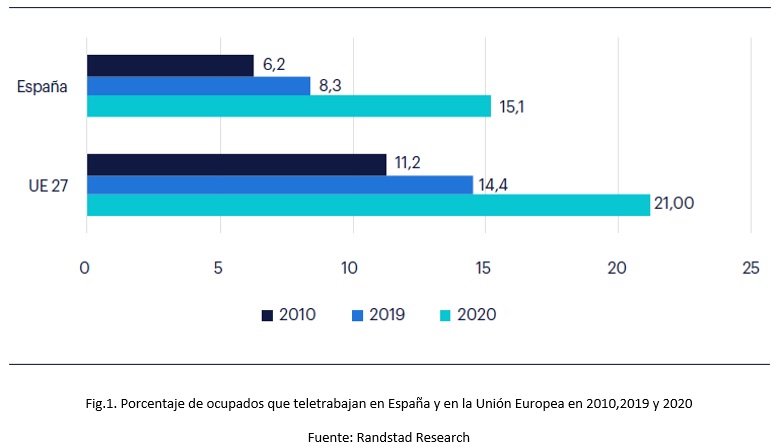
These data clearly indicate the potential of this sector since, although part of this huge volume of working days will be produced as a home office, the vast majority will take place in spaces that are better equipped than the private home.
Benefits of the hybrid model in flexible spaces
Being able to carry out professional activities in flexible workspaces brings many benefits to both companies and their employees:
- Flexibility, when sizing one's own spaces and choosing the optimal space for each occasion.
- Cost savings and control, by reducing the number of spaces needed and the exact knowledge of the monthly/annual costs.
- Sustainability and reduction of the ecological footprint
- Sustainability improvement by reducing the number and length of trips when working in "close proximity" spaces **Sustainability improvement by reducing the number and length of trips.
- Socialization, Team Engagement and Networking. As opposed to the Homeoffice, working in flex spaces allows the relationship and exchange of knowledge and experiences with others.
- Talent Attraction and Retention: The ability to attract and retain talent anywhere in the world is much more affordable and effective than salary bubbles.
- Employee satisfaction Studies show that 88% of workers consider themselves happier with these models. And happier means more productive.
However, the effective implementation of this model needs Platforms or "Brokers" of the space rental market that are able to offer a tool that allows professionals to work in them. Today, there are hundreds of sites that offer their own workspaces for rent in different modalities: flex, fix, office, meeting room, by hours, months or days.
An actor is needed to organize the market, to offer a tool to efficiently manage the day-to-day work of professionals and allow them to find the ideal space when they need it.
eekox, the Platform
eekox will be the Platform, a project incubated from the user's point of view, with a team of qualified professionals with extensive professional experience in the business world, and with in house developments oriented to a new lifestyle that is here to stay.
We are carrying out a national deployment to bring the new labor reality not only to the big metropolises, but also to the rural areas, the emptied Spain, under an atomized model and with a map of suggestive proposals for all kinds of needs.
At eekox we firmly believe that by adapting the way of working to people's lifestyles we will generate a positive impact on organizations, the environment and society. Our purpose is to promote a new, more flexible and human way of working. It is also time for Companies and Corporations to decisively address this change in the paradigm of work, which is actually a paradigm shift in our way of life.