How to fund your StartUp
Sun, 13 Mar 2022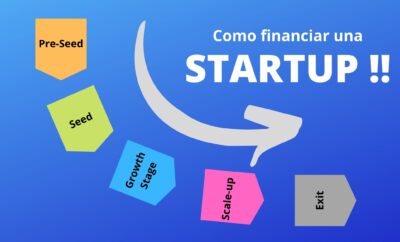
To move forward with a good business idea often requires capital to be able to tackle all the necessary tasks at the right time. It is very important to know which sources of financing we can turn to without paying an excessive or unnecessary price, especially in terms of equity. From eekox we want to encourage those who are undertaking and starting their adventure and therefore we leave you this post, in which we provide clues and ideas on this critical and delicate issue that is the search for capital.
What is a startup?
Before we begin, let's define what a startup is. According to the chamber of commerce, "a startup is a new or early-age company that presents great growth potential and commercializes products and services through the use of information and communication technologies. (....) They are businesses that go to market quickly to achieve the necessary growth and funding through digital transformation."
You can read this post we published a few weeks ago about the necessary steps for your startup to succeed.
What are the phases of a Startup?
It is important to give a brushstroke to know where we are, because in each phase our startup will have different investment and working capital needs and we will have to go to the right partner:
- Pre-Seed. There is only the idea, it is time to look for partners (if you don't have them and you want to have them) and sign a Partner Agreement with them. You will need some funding through the 3F (Family, Friends & Fools).
- Seed. It's time to validate the Business and drive it forward. You need to get funding through a participatory loan or a business angel.
- Growth Stage. The business model works and starts to have cash flow. But an injection of capital is needed for the business to grow according to the Business Plan. This is where investment funds come in.
- Scale-up Stage. The scalability of the business allows the startup to internationalize and attack different or complementary market segments to the initial ones. Expansion may be accompanied by alliances with other companies or the entry of private equity.
- Exit. This is the point we all want to reach, whether we execute it or not. It is the moment to exit to the stock market or to sell to another company. Or not.....
Bootstrapping
Even if the term doesn't ring a bell, it should always be the first choice. Bootstrapping refers to the ability to finance itself, using only the capital contributed by the founding partners and the capital generated by the business itself.
It has a fundamental advantage: the founding partners do not lose equity and maintain full decision-making capacity. There is no dilution derived from having to sell shares to investors, so you will always keep 100% of the company.
But it is also true that this mechanism is not viable in most cases. The very definition of a startup implies the existence of costs that will appear before the phases in which the company generates sufficient capital flows to sustain the cost (break-even).
Whatever the amount you need, you must keep in mind that any investor will fundamentally value two things, the business plan and the team. So let's see where and how we have to go to inject fuel to our business.
In the Pre-Seed phase
In this phase you are the investor. There is little more than an idea with a greater or lesser degree of maturity. It is the moment when the founding partners are encouraged to take the step of incorporating the company and make the first capital contribution. The normal thing is to constitute a SL with the minimum contribution, that is to say 3.000 € that have to serve to cover the first expenses of starting up the business. These expenses may be zero or very small or somewhat higher depending on your business. Some additional capital may be needed at this stage. For example, you need to develop an MVP in order to start verifying business hypotheses.
If the founding partners' contributions are not enough to cover these costs you can always resort to the 3F's, i.e. Family, Friends & Fools. You will be receiving a "soft loan" without the demands of other potential investors that you will have to resort to later.
Without it being a rule, we could be considering the need to cover between 5K€ and 30K€.
In Seed phase.
With the MVP in hand, it is necessary to start verifying the business hypotheses as broadly as possible. It is necessary to identify the target customer segments and reach them. And this will require a larger investment than what can be asked from the 3Fs (unless you are from a wealthy family). The capital needs at this point are not exorbitant, but they are necessary to cover a series of costs among which may be:
- Basic infrastructure for both hardware and services, laptops, licenses, AWS, etc.
- Evolutions of the MVP for which we may need to hire the services of a programmer.
- Small digital marketing campaigns
- We are thinking about a need for funding in a range between 50K€ and 200K€ that we can seek through:
Business Angels (Here you have a list of the 100 most active VCs in Spain in 2021).
Their way of operating is very varied, but compared to other types of financing they provide the value of helping, mentoring and guiding their startups. In exchange, you will give up part of your equity.
Crowdfunding.
With this modality we will advertise our startup to seek a large number of private investors, each of which will contribute a small amount in exchange for a fee. This can be in the form of shares in your company (with the resulting dilution and reduction of the equity of the founding partners) or in advantages as a future customer of the company, for example, a lower price than the RRP of the products or services of your startup. As it will be complicated to reach this type of "investors", there are companies such as Ufounders specialized in raising these rounds.
Public subsidy.
In Spain it is frankly difficult to find grants (non-refundable) although it is always advisable to be aware of what may be available, for example in Acelera Pyme or in the Autonomous Regions and City Councils.
Public financing.
Although the conditions are usually quite restrictive, ENISA is an option to obtain a participative loan with good conditions. You will not sacrifice equity with this option as ENISA will simply receive more in loan repayment if your business does well. Portals such as Fandit or people like GWSpain can advise and guide you in this world.
Private financing.
Banks are another option to get the loan you need. Although some banks have units specialized in startups (DayOne or BStartup) you may end up in your branch negotiating with the Director and they will deny it ..... Or they will grant it against a mortgage guarantee. Not all banks are receptive to a good business plan.
Financing with MGS (Mutual Guarantee Societies).
In the case of Spain, companies such as Avalmadrid or Iberaval can facilitate your access to private financing from banks by granting you the guarantee that the latter need. These SGRs will rely on your business plan to judge whether your idea can prosper and whether you will be able to repay the loan. Although this will not free you from putting some kind of guarantee, although less than that required by a bank and, usually, will not go against your assets if you can not repay the principal of the loan.
Growth Stage
The financing and/or subsidy that you have obtained in the pre-Seed stage will allow you to verify the business hypothesis and start having income. The business model works and starts to generate cash flow. Now an injection of capital is needed to grow the business according to the Business Plan. And this is where investment funds come in. The range of capital needed if your startup reaches this stage will vary greatly depending on the business itself, but we can talk about a range between €500K and €5M.
This first round of investment is known as Series A and what the company is looking for is the necessary investment to grow revenue until it reaches break-even, the revenue generated covers the cost of operation.
The normal thing in this phase is to turn to Venture Capital, which will invest in your company if it is convinced that by increasing sales the company will increase its margins and, therefore, will generate enough profit to recover its increased investment according to the agreed profitability.
The capital contributed by the VC will give him a sufficient shareholding in the company to control its decision-making bodies so that he can ensure that his contribution is used for the agreed purposes. This is usually an investor who will remain in the company for a period of between 5 and 10 years and who will demand the permanence of the startup's management team.
From this point on, and if the business continues to grow, Series B, Series C and, perhaps, Exit will follow.
Here is the list of Spanish Startups with some of the Spanish VCs.