Digitalization and leadership model: the challenges for companies to adopt hybrid models.
Sun, 30 Jan 2022
The changes in the world of work resulting from the cataclysm brought about by COVID-19 pose a whole catalog of new challenges for companies.
Professionals and individuals have changed their perception and their scale of values when it comes to deciding what to choose from among the options for their future career. The PWC study on the future of work provides very interesting data on the changes that are taking place. The traditional model is bound to coexist with new hybrid models and this is both a cause and a consequence of many other profound cultural changes.
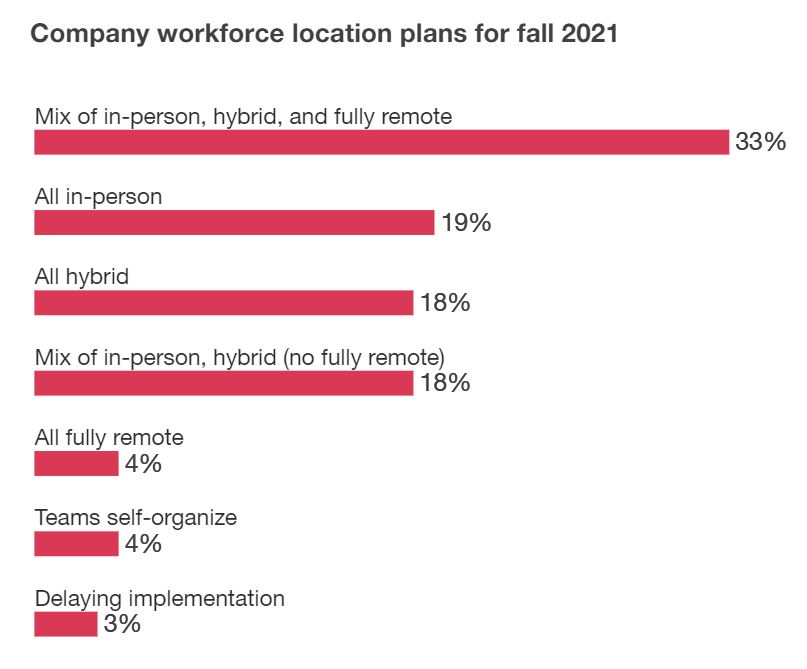
Only 19% of the 752 companies surveyed contemplate a purely face-to-face model. And this is a challenge because we will have to be able to make the best of both worlds, physical and virtual, in order not to fail. According to the prestigious Forrester (Predictions 2022: This Is A Year To Be Bold), "... only 10% of companies will switch to a fully remote model, and 30% will return to a fully face-to-face model. The remaining 60% will move to a hybrid model, and a third of those companies will fail in their first attempt to work anywhere." And this has to do above all with two aspects: the digitization of business and the change in leadership culture. But let's take it one step at a time.
The necessary digital transformation
Spain is still lagging far behind in these tasks. Despite the progress made in recent years, the Spanish industrial fabric is far from the level of digitalization required to minimize the risk of failure in the transition to hybrid work models. EU funds are a unique opportunity that we hope to take advantage of. But it is true that the historical rigidities of the Spanish administration do not augur well for anything new. The Digital Toolkit Program would be an opportunity if it were not for the mechanism of the aid itself. SMEs will only be able to "ask" a Digitizing Agent to do the work for them..... And this greatly restricts the ability of SMEs to meet their real needs. Let this not be another missed opportunity....
The change in the leadership model
Presentialism and control have historically been two scourges of the Spanish workplace. "I'm not leaving until my boss leaves" and "if I don't control them they don't do anything, they are lazy" are two maxims that are still very real in this country. Even in May 2020, this Robert Walters study showed that 69% of managers would like to return to face-to-face work, while 90% of workers would like to have the possibility of teleworking. No comments.
In its report, PWC includes two facts that are significant because they strongly appear in the professionals' answers.
The first is that flexibility appears as one of the reasons for leaving a job, immediately after economic issues.
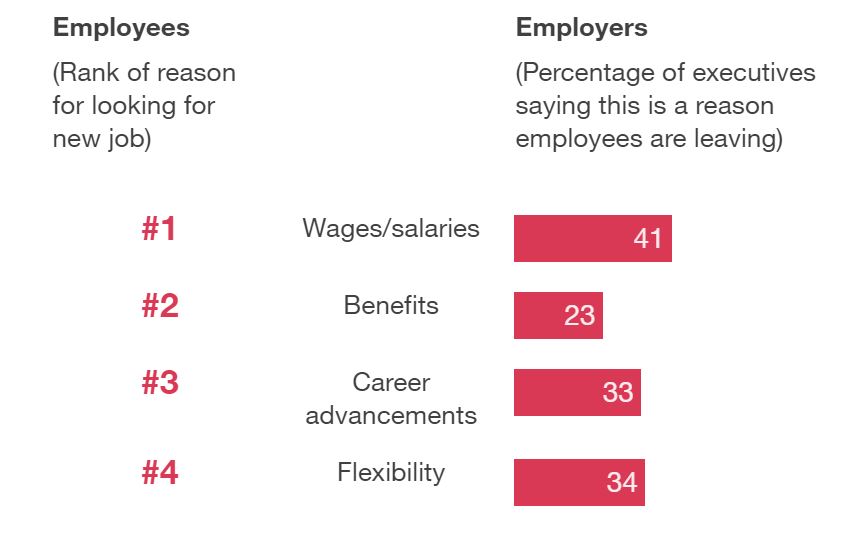
And the second is that flexibility, both in work planning and in the place to perform it are among the top 4 improvement demands of professionals:
That the future of work is hybrid seems a clear trend. But companies will have to adapt to respond to the flexibility and autonomy demanded by people. To meet this challenge, offering professionals the freedom to choose where they work may be one of the tools that can help improve the competitiveness of Spanish companies and increase talent retention. Especially in emerging IT sectors.
eekox offers companies a tool where employees can find those spaces of proximity that meet their needs at any given moment. We are already present in Madrid, Barcelona, Valencia, Almería, Alicante, Albacete, Málaga, Zaragoza or Las Palmas.